
Vision inspection, laser, photoelectric and load-cell sensors: who does what
Vision and sensors are not competing options. Use a sensor whenever the answer can be written as a number or an on/off state, and give vision only the questions no single physical quantity can express: an action, a sequence, a shape, a surface. A station carrying a proximity switch, a load cell and a camera at once is normal.
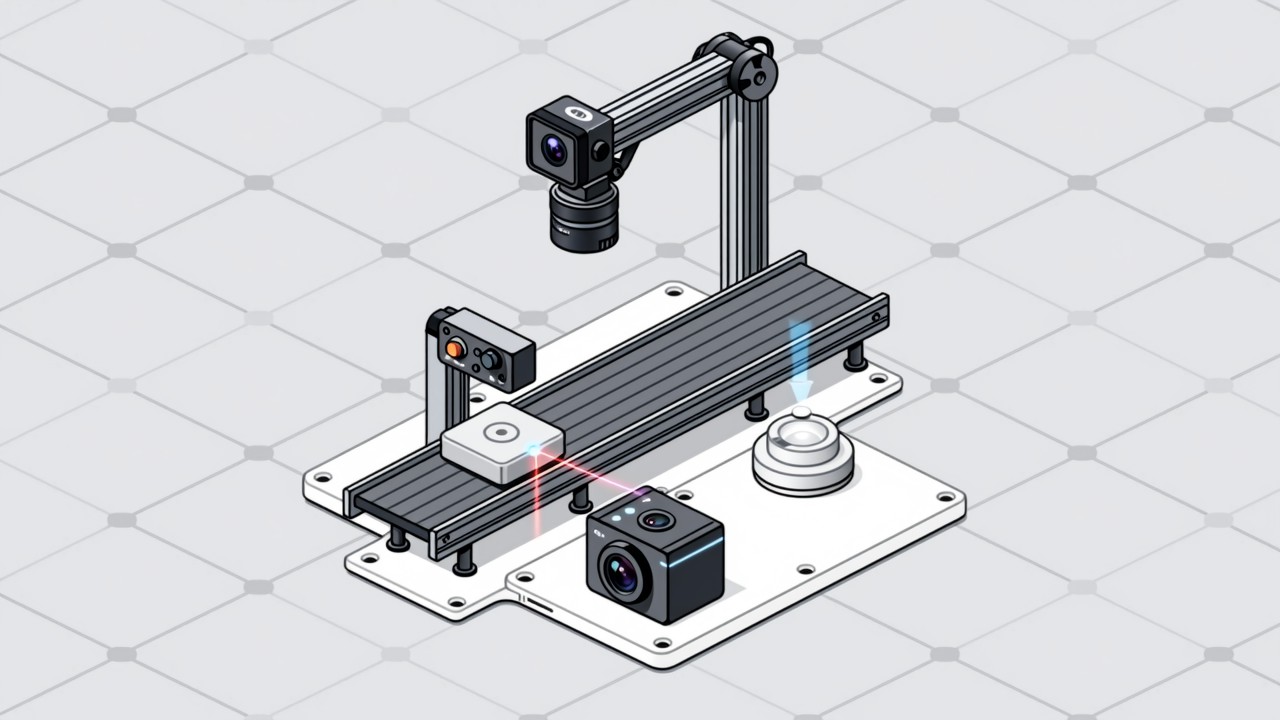
Key takeaways
- If the answer fits a numeric band or an on/off state, a sensor usually beats vision on cost and reliability.
- Sensor logic for sequences gets expensive once several stations or several part numbers are involved.
- What only vision can judge: an action sequence, a shape or orientation, and anything tied to the part number.
- When judgement depends on feel, internal structure or micron-level measurement, a dedicated gauge beats a general-purpose camera.
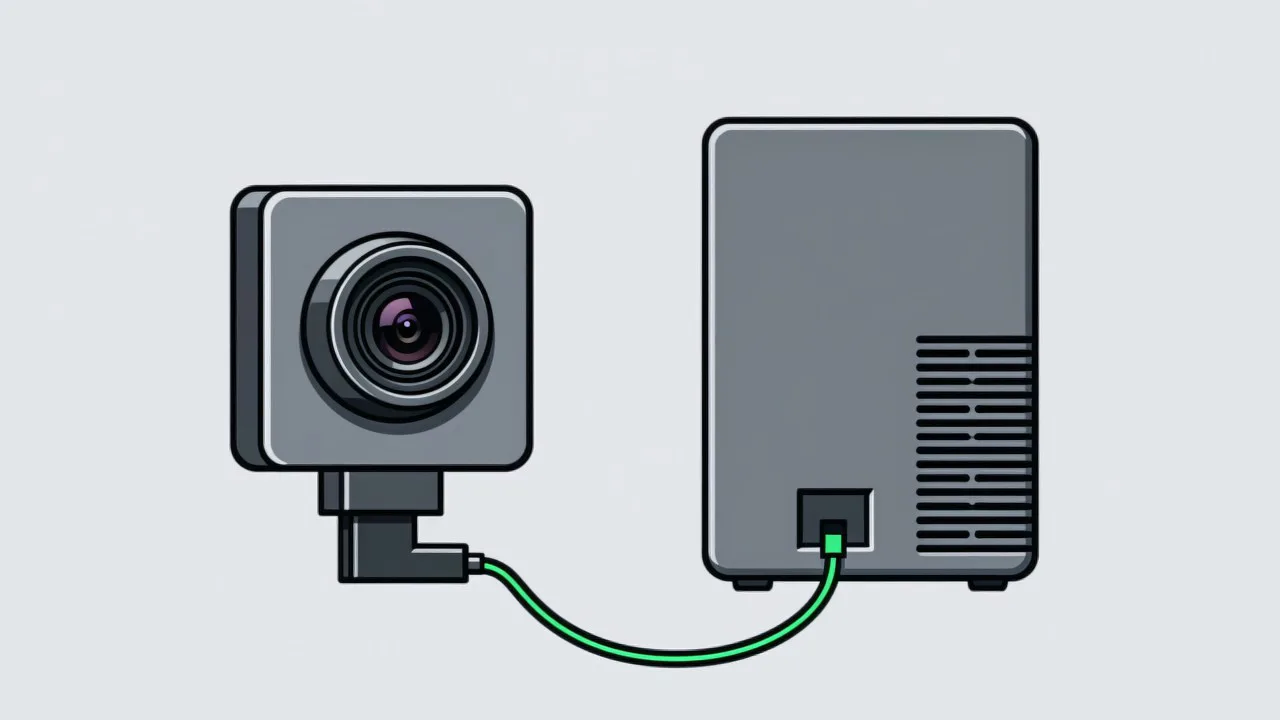
Vision inspection and sensors are not competing options. The practical rule on most lines is this: if the answer can be expressed as a number or an on/off state, use a sensor; give vision only the questions no single physical quantity can express — an action, a sequence, a shape, a surface. A station that carries a proximity switch, a load cell and an industrial camera at the same time is entirely normal, because each is answering a different question.
Rule one: if a sensor can decide it, do not use an image
A sensor returns a switch state or a scalar: present or absent, seated or not seated, a weight, a torque, a beam broken. The threshold is clear, the response is measured in milliseconds, the reading is immune to lighting and surface colour, the cost per point is low and there is almost nothing to maintain. Wherever the answer fits inside a numeric band or an on/off state, a sensor will almost always beat vision on cost and reliability. Two sensors can also produce a sequence — fire in order and you have a crude timing check — but once the sequence spans several stations and part numbers, or once you must tell “done wrong” apart from “not done at all”, the logic grows complicated fast, and wiring, programming and every later change get more expensive. The moment the logic stops being simple is the moment a Visual AI SOP System earns its place.
| Question | Preferred method | Why |
|---|---|---|
| Present / seated | Proximity, photoelectric or limit switch | Direct, reliable on/off state, milliseconds, unaffected by surface finish |
| Weight / count | Load cell, counting photocell | Returns a number directly; no image reconstruction needed |
| Torque / tightening | Torque transducer, servo current monitoring | A process value read live, more accurate than judging tightness by eye |
| Temperature / pressure / flow | The matching process instrument | These are physical quantities vision cannot sense at all |
| Action order / was a step done | Vision AI | No single physical quantity expresses “scan before loading” |
| Cosmetic defect / shape / colour | Vision | An image problem with no sensor equivalent |
| Orientation / wrong part | Vision | Orientation and part number are shape information |
Three questions only vision can answer
- An action sequence. Scan, then label, then press. Do them out of order and the unit still passes. A sensor only knows the scanner fired; it cannot say whether that happened before or after loading.
- Shape and orientation. A reversed connector, a skewed seal, a label on the wrong face — all shape problems, with no threshold to set.
- Anything tied to the part number. One station may run a dozen part numbers in a shift, and the correct action differs for each. Sensor logic is fixed and hard to change; vision can switch its rules with the recipe.
What these three have in common is that none of them is asking for a quantity — they are asking for a state or a relationship. A sensor compresses the physical world into a number, and it does that very well. But once a judgement needs to understand “did this action happen before that one” or “is this part facing the right way relative to its neighbour”, a number is no longer enough and you have to go back to the image itself.
The boundary: when vision is the wrong tool
Vision is not a universal tool. Treat the following cases with caution, and in some of them drop the vision option altogether. Where judgement depends on feel, torque or internal structure the camera cannot see — weld penetration depth, thread engagement length. Where the defect criterion is itself unclear and nobody agrees on pass or fail, which means solving the standard first, as in five ways to prevent a missing operation. Where the cycle is very fast and the measurement is micron-level, which belongs to laser profilers and vision measuring machines rather than a general-purpose camera. Where lighting, dust, vibration or oil mist cannot be brought under control, because unstable imaging defeats any algorithm. And where volume at the station is very low and the consequence of an error is mild, because the payback will not close and manual confirmation is simply cheaper.
What to decide first
Four steps, in order
- Step 1: break the work into actions
Split the station into an observable sequence and mark each step as decidable by a physical quantity or only by an image. The wider selection logic is set out in the visual SOP selection checklist.
- Step 2: place the sensors first
Put sensors on every point that can be decided by a switch state, so vision is left only with the steps that genuinely need an image.
- Step 3: validate vision on real samples
Shoot samples under the real lighting and cycle time, confirm the imaging is stable, then assess accuracy. The method is in the visual SOP site assessment checklist.
- Step 4: bring the data together
Record sensor signals and vision results under one timestamp and write them into MES, so you never end up with two logs that disagree.
Common questions on sensor and vision division
Can vision inspection replace photoelectric sensors entirely?
No, and there is no reason to try. Switch-state decisions are cheaper, more reliable and nearly maintenance-free with a photocell. Vision is there to cover the action, sequence and shape judgements a sensor cannot express.
Can sensors alone prevent a missing operation?
On a line with few steps, a fixed sequence and a single part number, yes. Once part-number changeover, action order or cosmetics enter the picture, the sensor logic gets complicated quickly and is expensive to change later.
Do vision and sensors together mean paying twice?
Not when the split is clear. Double spend usually appears where nobody decomposed the actions first and points were placed by instinct, so the same question gets answered by two methods.
Should your station use a sensor or vision?
Tell us the actions and the hard calls, and we will help draw the line between them.
Related articles
-
Alarm Fatigue: Why the Floor Turns the System Off
Many visual SOP systems are not beaten by technical problems — they are muted by…
Read more → -
Visual SOP Camera Selection and Mounting
Camera selection for visual SOP is not the same as for product inspection. The s…
Read more → -
Vision Monitoring at the Semiconductor Die Bonder
Semiconductor packaging stations are characterised by high precision, fast cycle…
Read more → -
Wrong-Assembly Alarms Without the False Alarms
The most common reason a visual SOP project fails is not poor recognition — it i…
Read more →
Need specific advice for your production line?
Our engineers can share practical approaches to process error prevention and SOP compliance inspection for your scenario.
Request a free trial plan