
Line Scan Cameras
A line scan camera has a sensor that is one row of pixels, or a few rows, and it builds an image by taking a picture of a thin slice of the product over and over as the product moves past it. The resulting image is a composite whose geometry depends on how fast the product was moving. This makes the camera useless without controlled motion and an encoder, and it makes it the only practical answer for a set of problems where the product is continuous, very long, or cylindrical.
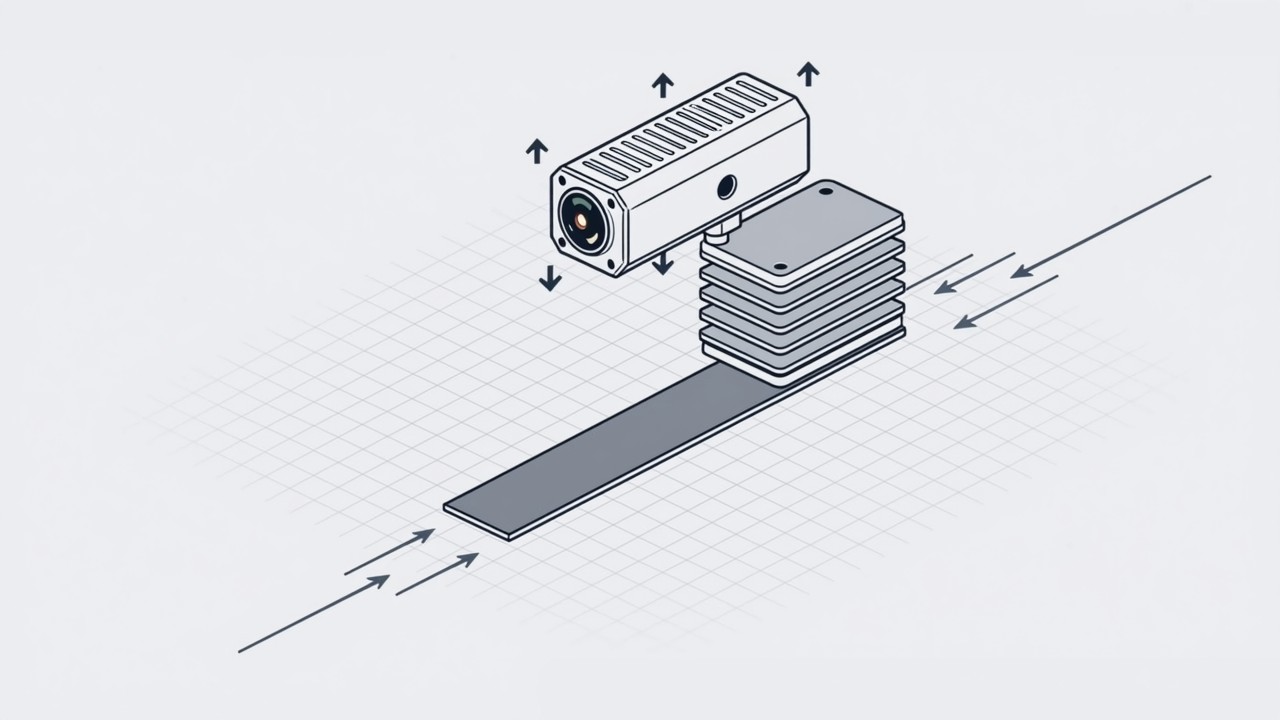
Key takeaways
- A line scan camera needs motion, controlled lighting and an encoder — there is no still image.
- It is the right answer for continuous material, very long parts and cylindrical surfaces.
- Image geometry depends on the ratio between line rate and product speed.
- Non-uniform motion shows up directly as stretched or compressed regions in the image.
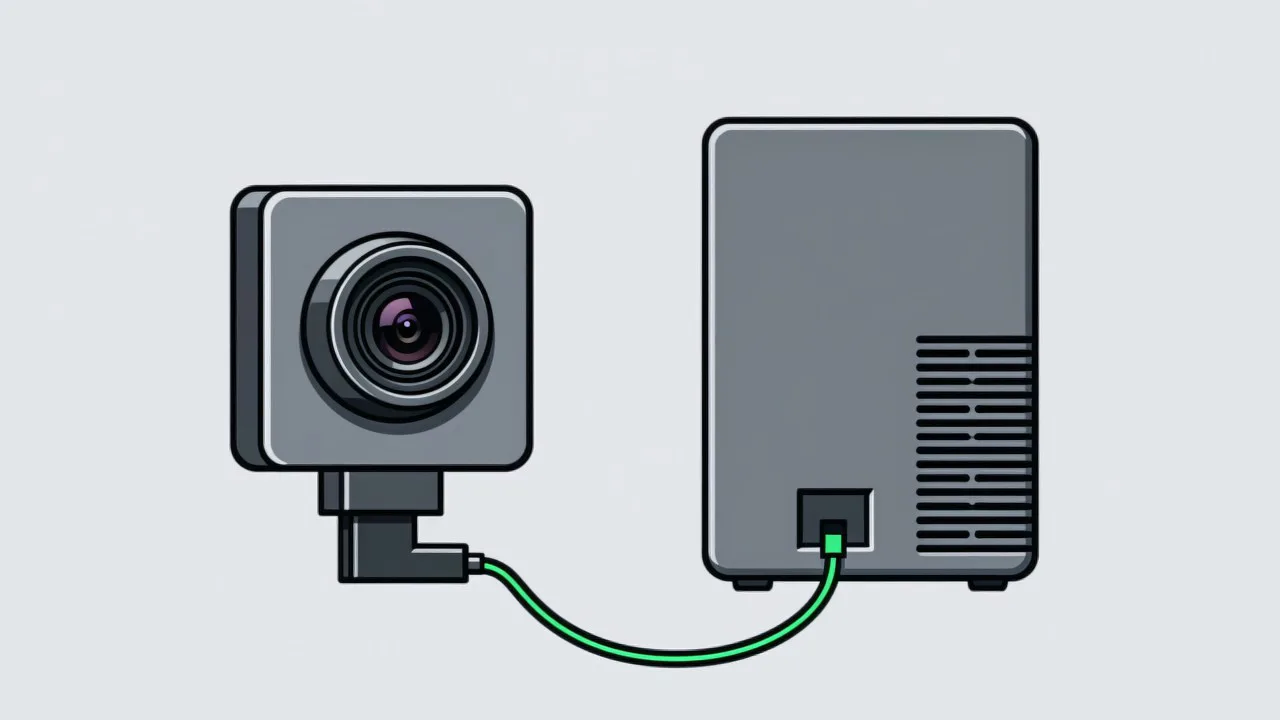
The difference between an area camera and a line scan camera is not resolution or speed, it is how the image comes into being. An area camera captures a two dimensional frame at an instant. A line scan camera captures one row at a time, repeating as the product moves, and the image is assembled from those rows. Everything distinctive about the technology follows from this: it needs something to be moving, it needs to know how fast that thing is moving, and the spatial relationships in the finished image are a record of the motion as much as of the product.
Where it is the only answer
- Continuous material. Film, foil, paper, fabric, wire, cable, extruded profile, sheet metal from a coil. The material does not end, so there is no frame to take. An area camera could only sample it in pieces, with seams and gaps between them.
- Very long parts. A part several metres long, measured for defects along its whole length, would need either a very large sensor or a mosaic of area cameras. A line scan camera covers it with one sensor and one lens as it passes.
- Cylindrical surfaces. A rotating part passes a line scan camera and unrolls into a flat image — the surface of a shaft, a can, a bottle, a bearing race. Try that with an area camera and you get a fisheye view of one side and nothing of the rest.
- Very high resolution in one direction. Where the requirement is a great many pixels across a narrow strip, a line scan sensor gives more of them for the money than a comparable area sensor.
The counterweight is that everything must line up. The product has to move at a speed the system knows, the lighting has to be intense and continuous enough to freeze a moving row, and the line rate has to be locked to the motion. A line scan station that is set up well is excellent; one where the encoder signal is noisy or the speed varies is worse than an area camera, because its failures are geometric and therefore hard to see.
Speed and line rate have to agree
The relationship is simple and unforgiving. If the product moves at a speed of V millimetres per second and you want a resolution of R millimetres per line across the direction of motion, the line rate must be V divided by R lines per second. Get it wrong and the image is distorted: too few lines and the product looks stretched along its length, too many and it looks compressed. Either way, a circular feature becomes an ellipse and every measurement along the motion direction is scaled by the same wrong factor.
| Product speed | Required line rate | Note |
|---|---|---|
| 0.1 m/s | 1000 lines/s | Comfortable for most sensors |
| 0.5 m/s | 5000 lines/s | Common on web and foil lines |
| 1 m/s | 10000 lines/s | Needs a fast sensor and a bright, short exposure |
| 3 m/s | 30000 lines/s | Light budget becomes the limiting factor |
This table hides the real constraint. Each line is an exposure, and a short exposure at a high line rate means very little light per line, so the illumination has to be correspondingly intense. In practice the light source, not the sensor, sets the speed limit on a line scan station. This is why line scan setups so often use high intensity bars or laser illumination rather than the diffuse panels an area camera would use.
Practical checks before committing
Before choosing a line scan camera, confirm three things on the real line. That the product motion is consistent enough over the length being inspected — measure it, do not assume. That the lighting can deliver the intensity the line rate requires at the exposure time the speed allows, which usually means a trial with the actual source. And that the encoder can be coupled to the material rather than to something upstream of the slip, because that coupling determines whether the geometry is trustworthy. If any of the three is uncertain, an area camera with a mosaic, or a different inspection position, is often the cheaper answer.
Common questions about line scan cameras
Can a line scan camera work on a stationary product?
Only if you move the camera instead, which is done for scanning flat parts on a stage. The principle is unchanged — something has to move, and the line rate has to match that motion. With neither moving there is no second dimension and the image is just a line.
How is a colour line scan camera different?
It has three rows of sensors with colour filters, and the three rows are physically separated on the chip. That separation means each colour is sampled at a slightly different position along the motion direction, and the software has to line them up. It works, but it makes the calibration of the motion more critical, and it costs light because each row only receives its own colour.
What about a time delay integration sensor?
A time delay integration sensor has many rows and shifts the charge along with the moving image, accumulating exposure as the product passes. The effect is far more light collected at the same line rate, which is how very fast lines are inspected at all. The price is that the shift rate must match the product speed precisely; if it does not, the accumulation smears rather than sharpens. It is a specialist tool for high speed, low light applications.
Working with continuous material?
Tell us the material, the speed and the resolution you need. We will work out whether a line scan camera is the right answer and what light it demands.
Related articles
-
Alarm Fatigue: Why the Floor Turns the System Off
Many visual SOP systems are not beaten by technical problems — they are muted by…
Read more → -
Visual SOP Camera Selection and Mounting
Camera selection for visual SOP is not the same as for product inspection. The s…
Read more → -
Vision Monitoring at the Semiconductor Die Bonder
Semiconductor packaging stations are characterised by high precision, fast cycle…
Read more → -
Wrong-Assembly Alarms Without the False Alarms
The most common reason a visual SOP project fails is not poor recognition — it i…
Read more →
Need specific advice for your production line?
Our engineers can share practical approaches to process error prevention and SOP compliance inspection for your scenario.
Request a free trial plan