
Telecentric versus Standard Lens: How to Choose
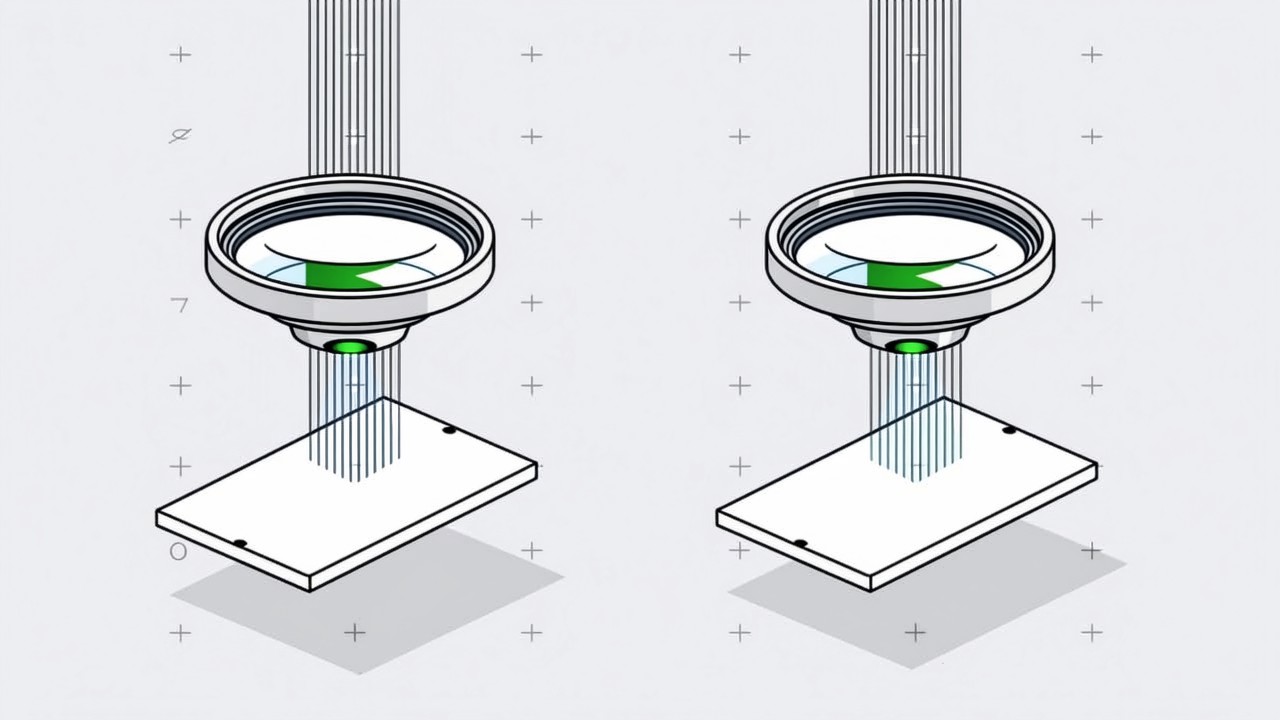
A standard lens forms a perspective image: bring the part closer and it gets bigger on the sensor. That is common sense in photography and a source of error in metrology. A part that moves a millimetre within the depth of field measures differently, and how much differently depends on the distance and the magnification — it is not a constant, so it cannot be subtracted out. A telecentric lens makes the chief rays run parallel to the optical axis, so magnification does not change with object distance. This article covers what each of the three telecentric types solves, when one is genuinely required, and what it costs.
Key takeaways
- Telecentric buys constant magnification with distance, not a larger depth of field.
- Height differences, reported measurements, floating part position and edge-of-field measurement are the four drivers.
- Field of view can never exceed the front aperture, so large-field telecentric lenses are large and expensive.
- Low light throughput is the cost most often forgotten. Budget for lighting and cycle time together.
A standard lens forms a perspective image: bring the part a little closer and it appears a little larger. A part floating a millimetre forward within the depth of field therefore measures differently. The awkward part is that the amount of change depends on the distance and the magnification rather than being a constant, so there is no offset that cancels it — a different position each cycle means a different error each cycle. A telecentric lens makes the chief rays run parallel to the optical axis, so magnification stays fixed as the object distance changes. That entire dimension of error is removed at the source rather than corrected afterwards.
Three telecentric types, and what each one solves
| Type | Telecentric side | What it solves |
|---|---|---|
| Object side | Toward the part | Magnification independent of working distance, so measured size is stable |
| Image side | Toward the sensor | Slight defocus at the sensor does not change magnification; edge brightness is more even |
| Double | Both sides | Both of the above; the usual choice for measurement |
What the market calls a telecentric lens is usually object side or double telecentric. Dimensional measurement almost always means double telecentric. Where the only goal is more even brightness toward the edge of the image — avoiding the threshold drift that vignetting causes — an image side telecentric may be sufficient, and there is no reason to pay for the object side specification. Writing that sentence into the requirement saves money that would otherwise disappear into an unused specification.
When a telecentric lens is required
- Parts with thickness or height steps. Measuring a standing cylinder, the depth of a flange or the step between two faces: a standard lens gives a different magnification at each height, so the dimension carries a systematic offset that tracks the height.
- Absolute dimensions that must be reported. A pass or fail verdict can tolerate a magnification error of a few percent; a reported measured value cannot, particularly where the record is retained.
- Parts that inevitably float within the depth of field. Parts on a conveyor or placed by a robot have limited positional repeatability. A telecentric lens removes that dimension of error entirely and leaves the rest to mechanics and algorithms.
- Features at the edge of the field. Standard lens distortion is worst at the edge, so dimensions measured near the border are the least accurate. Telecentric distortion is typically within a few parts per thousand, so one conversion applies across the whole field.
What it costs
The first cost is that field of view is limited by the front aperture. The field can never exceed the clear aperture at the front of the lens, so working across a 200 mm field means a front element larger than 200 mm — and that space has to come out of the machine envelope. The second cost is that working distance is fixed near a design value with very little adjustment range, which leaves almost no slack when a workstation is modified. The third is price: typically an order of magnitude above a standard lens for the same field, and double telecentric adds another step.
A fourth cost is easy to overlook: light throughput. The angular aperture of a telecentric lens is small, so it naturally collects less energy than a standard lens, and the same brightness requires a stronger light or a longer exposure. On a fast line that turns straight into a cycle time problem, and cycle time lost to exposure is not recovered by algorithms later. Lighting and the inspection time budget should therefore be worked out at selection time, rather than discovered when the hardware arrives.
Telecentric and depth of field
Telecentric lenses are often described as having a large depth of field, which is not quite right. The advantage is not a deeper field but constant magnification within whatever depth of field exists — and that depth is still limited by aperture, wavelength and magnification, often shallower than a standard lens of the same field. What it solves is dimensional consistency inside the sharp range, not the ability to image a taller object. Where the height range exceeds the depth of field, the correct answers are stepped scanning, two cameras looking from opposite sides, or a 3D method. Expecting the lens to stretch its depth of field is not one of them.
Common questions about lens selection
Can calibration of a standard lens replace a telecentric lens?
It removes part of the distortion but not the change of magnification with object distance. Calibration yields a fixed pixel size; if the part position itself varies, the actual magnification varies with it, and there is no fixed compensation. Where a fixture holds the part consistently, a calibrated standard lens is usually sufficient. Where it cannot, telecentric or a firmer mechanical constraint is the answer.
Do telecentric lenses always have a small field of view?
Increasing the field increases the aperture and the volume together, so large field telecentric lenses are both big and expensive. The common practice is to break a large part into several local fields measured with smaller telecentric lenses, then unify the coordinates through calibration.
How often does a telecentric lens need to be re-verified?
The lens itself is stable; long term care is mainly cleaning and inspection. What needs periodic re-verification is the whole chain: whether camera, lens, bracket or light have shifted, and whether the calibration is still valid. That cycle is the same subject as calibration review, and the cadence is set out in calibration and drift.
What lighting suits a telecentric lens?
Coaxial illumination is the most common pairing, because the parallel optical path lets a beam splitter fold light into the field efficiently with little glare. Note that the splitter has to match the clear aperture of the lens, so a larger field pushes up the size and cost of both splitter and light. Where the field is large and the surface is not especially reflective, a dome or low angle bar light outside the lens is often the better value.
Does your part move within the depth of field?
Tell us how the part is presented, its dimensions and the tolerance, and we will say whether a standard lens is enough or a telecentric lens is required.
Related articles
-
Alarm Fatigue: Why the Floor Turns the System Off
Many visual SOP systems are not beaten by technical problems — they are muted by…
Read more → -
Visual SOP Camera Selection and Mounting
Camera selection for visual SOP is not the same as for product inspection. The s…
Read more → -
Vision Monitoring at the Semiconductor Die Bonder
Semiconductor packaging stations are characterised by high precision, fast cycle…
Read more → -
Wrong-Assembly Alarms Without the False Alarms
The most common reason a visual SOP project fails is not poor recognition — it i…
Read more →
Need specific advice for your production line?
Our engineers can share practical approaches to process error prevention and SOP compliance inspection for your scenario.
Request a free trial plan