
Lighting Aging and Degradation
Lighting receives a great deal of attention when the scheme is designed and very little afterwards, where it is treated as a consumable. But its output changes, and the way it changes is more complicated than most people assume: not a slow linear dimming, but a fast initial fall followed by a gentler one; not only a loss of brightness but a shift in spectrum; and not uniform across the array, because individual emitters age at different rates. Together, these turn a lighting scheme that worked well into one that quietly stops working.
Key takeaways
- Output falls quickly at first and slowly afterwards, so new stations change fastest.
- The change is not just brightness — the spectrum shifts too, which matters more for colour.
- Emitters from different batches differ; spares have to be managed as batches.
- Replacing a light source requires re-validating the criteria, not just matching brightness.
Light emitting diode output decays on a characteristic curve: a comparatively quick fall over the first few hundred hours, then a much slower long term decline. For a new station that means the imaging conditions change fastest in the first months of its life. If the criteria were set tightly during that period, they may fail later as the decline continues; if they were set loosely enough to accommodate it, they may be too loose from the start. Knowing the shape of the curve explains a pattern that otherwise looks mysterious — a station that worked well for two months and then began producing problems.
Three ways it changes
- Overall dimming. The most obvious form: mean grey level falls and contrast with it. In a threshold based algorithm this changes the segmentation directly — a defect that used to separate from its background may stop separating, with nothing else altered.
- Spectral shift. A white source changes colour temperature as it ages, drifting warmer or cooler; a colour source whose channels decay at different rates changes the balance between red, green and blue. A monochrome camera is largely indifferent to this. A colour inspection sees the whole image shift and its colour criteria go out of tolerance.
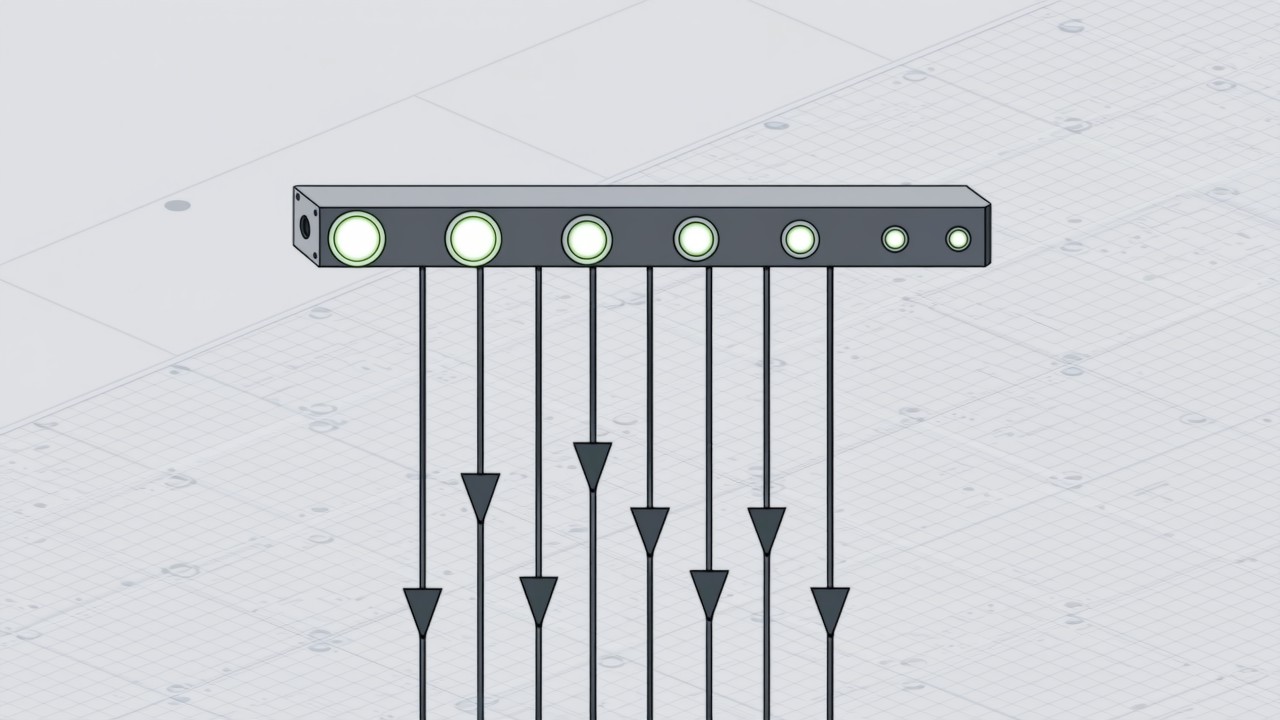
- Non-uniform decay within the array. In a row of emitters, those near the supply or in the worse thermal position fade faster, so the distribution across the field of view changes rather than the overall level. This is the most insidious of the three, because the centre of the view may look unchanged while the edges have lost a noticeable amount — and the edges are often where the defects are.
| Symptom | Possible cause | How to confirm |
|---|---|---|
| Image uniformly darker | Light decay; driver output falling; dust on the lens | Compare against historical reference readings; test light and driver separately |
| Edges darker than centre | Non-uniform array decay; contamination on a diffuser or reflector | Image a uniform white card and inspect the grey level distribution |
| Colour shifted overall | Spectral drift; camera white balance changed | Compare against a colour chart; confirm white balance settings are unchanged |
| Image flickering in level | Unstable driver; poor connection; ambient light intrusion | Sample the mean grey level continuously and look for periodicity |
| Results unstable on one lot | Ambient light varying, for example from a skylight | Repeat with ambient light blocked and compare |
What to do about it
The first measure is margin. Since output will fall, a lighting design should not run the source at its rating — both to extend its life and to leave room to compensate later. Drive current can be raised to make up part of the loss, but only if the initial operating point was not already at the ceiling. That margin belongs in the scheme document, rather than being decided by whoever sets up the station.
The second is monitoring, which the reference sample and a uniform card between them provide, as described in the daily check. What deserves emphasis here is the frequency. Because the initial decline is the fastest part of the curve, a new station should be monitored more closely in its first months and less often thereafter. Many sites set one interval for every station and thereby miss exactly the phase where monitoring was most valuable.
Spares, briefly
A light source is a consumable and should have a spare, but how the spare is stored is often overlooked. Buy it with the station, from the same batch, and store it sealed, dry and out of sunlight, with the purchase date recorded. The same batch matters because the source itself ages in storage, and because a model bought three years later is likely to be built with a later process whose characteristics are not necessarily identical. If only a newer batch is available, image it against the source in use under controlled conditions before accepting the swap.
Common questions about lighting aging
How long does a light source last?
It depends heavily on the model, the drive current, the thermal design and the hours of use, and no general figure is meaningful. The reliable approach is not to trust a rated life but to act on your own monitoring data, arranging replacement when the reference readings show a trend. A rated life can inform purchasing; it should not be the only trigger for replacement.
Can software compensate for the decay?
Partially. Monitoring the mean grey level and adjusting exposure or drive current to hold the image statistics steady addresses overall dimming. It does not address spectral drift or uneven decay within the array, because those change the structure of the image rather than its level, and no gain adjustment recovers them. Auto-compensation is a useful tool, not a reason to stop maintaining.
Should ambient light be treated as part of the lighting?
It should be treated separately. Ambient light is an external variable that changes with time of day, season and activity in the building, and it is usually uneven. Blocking it is the first choice; where that is impossible, assess its influence as described in shopfloor environment and monitor it as a separate item. Monitoring the two together leaves you unable to tell which one moved.
How old is your light source?
Tell us the model, the duty cycle and what you are seeing. We will say whether it needs replacing and what to verify before and after.
Related articles
-
Alarm Fatigue: Why the Floor Turns the System Off
Many visual SOP systems are not beaten by technical problems — they are muted by…
Read more → -
Visual SOP Camera Selection and Mounting
Camera selection for visual SOP is not the same as for product inspection. The s…
Read more → -
Vision Monitoring at the Semiconductor Die Bonder
Semiconductor packaging stations are characterised by high precision, fast cycle…
Read more → -
Wrong-Assembly Alarms Without the False Alarms
The most common reason a visual SOP project fails is not poor recognition — it i…
Read more →
Need specific advice for your production line?
Our engineers can share practical approaches to process error prevention and SOP compliance inspection for your scenario.
Request a free trial plan