
Can One Camera Serve Several Stations?
Covering several stations with one camera is a legitimate engineering choice, and it is often dismissed too quickly for reasons that turn out not to matter. The real constraints are spatial: how far apart the stations are, how loose the takt is, and whether the camera can move. Where one camera is genuinely stretched, the usual culprit is resolution at distance or the case for hardware synchronisation — not the camera count itself. This article sets out the three viable approaches and the conditions under which each stops working.
Key takeaways
- Sharing works when stations are adjacent and takt is loose; distance and tight takt are the two real limits.
- A gantry or rail gives range but costs a positioning mechanism, which needs calibration and shows wear.
- A robot-mounted camera provides flexibility but its trajectory must be repeatable to the pixel.
- Where several viewpoints must be simultaneous, one camera cannot substitute for several whatever the reason.
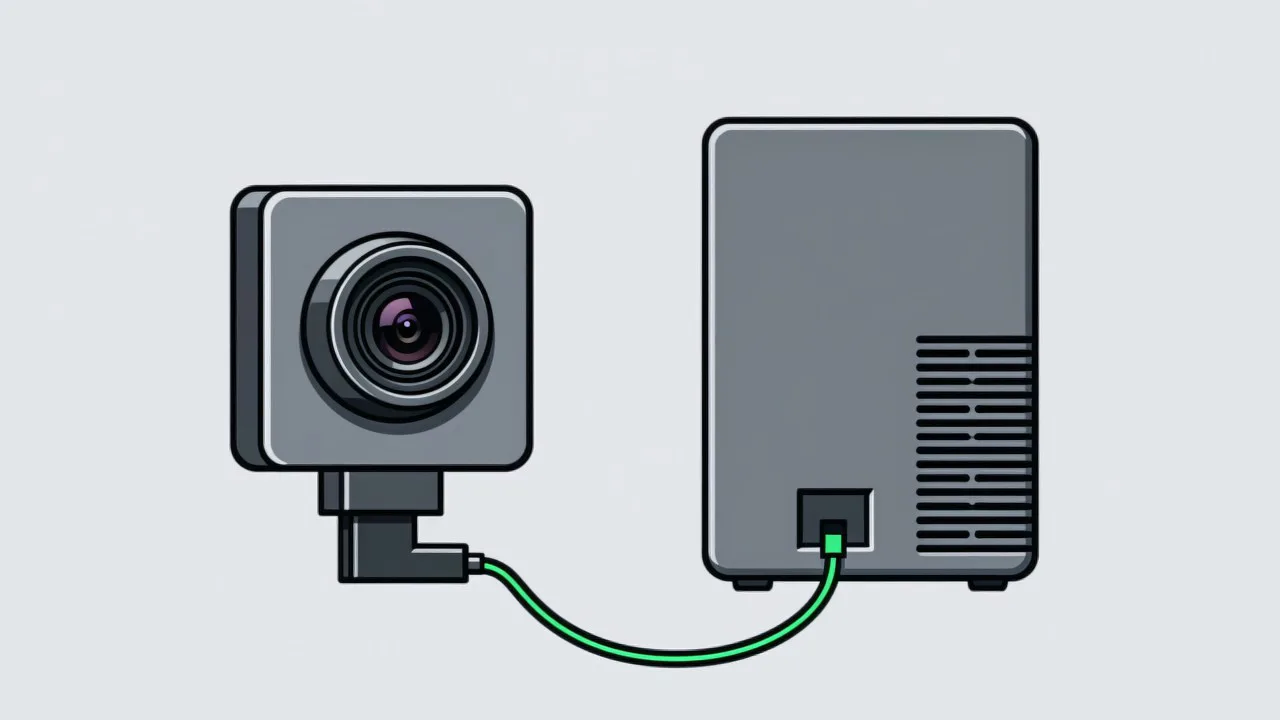
Covering several stations with a single camera is a real engineering choice and often gets dismissed too quickly on the assumption that it must be inferior. In many cases it is not — if the stations are adjacent and the takt is loose enough for the camera to serve them in turn, one camera does the job of three at a third of the hardware cost, with less mounting, less wiring and fewer calibration routines to keep current. What genuinely limits it is spatial rather than conceptual: how far apart the stations are, how much time there is, and whether the camera can physically move. Understanding which of those bites is the whole of the decision.
Three workable approaches
| Approach | What it suits | What it costs |
|---|---|---|
| Wide field of view | Two or three adjacent stations within one frame | Resolution per station drops; check items must tolerate it |
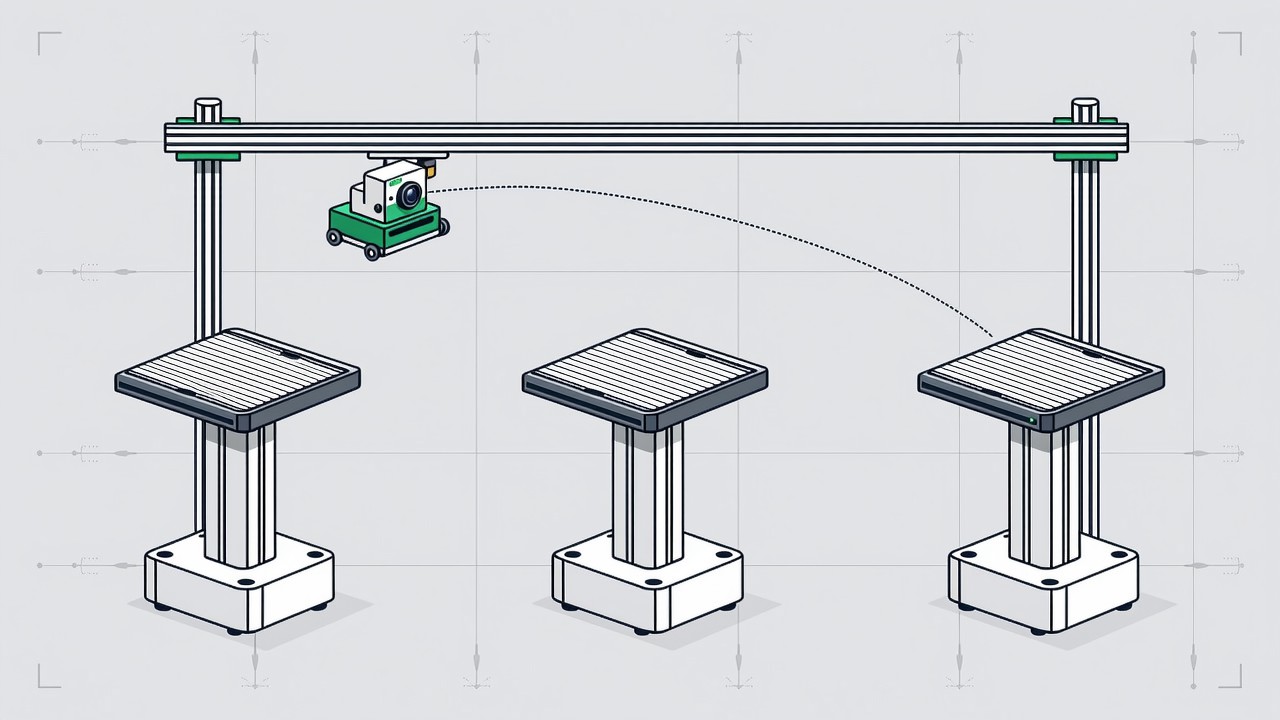
| Rail or gantry traverse | A row of stations along one axis | A positioning mechanism, plus its calibration and wear |
| Robot mounted | Flexible coverage with frequent path changes | Trajectory repeatability and cycle-time sharing with production |
The first is really a framing question. If two stations fit in one frame with enough pixels per station to judge the check items, the camera simply watches both, and the only cost is the trade of resolution for coverage. The second adds a movement axis, which buys range and brings a mechanism: the rail must be positioned accurately, stays accurate over time, and does not become the thing that breaks while production is running. The third borrows the robot's motion, which is flexible and usually means sharing the production cycle, so it only suits a station that has spare time. The resolution trade-off in the first option connects to choosing a camera, and the timing side to station time budgets.
What breaks it
- Distance against resolution: the further a station is from the camera, the fewer pixels cover one detail. Once the pixel count on a check item is insufficient, no threshold recovers it.
- Time against takt: if the camera must serve three stations within one takt, its own capture and processing time must fit the window with margin. A tight line leaves none, and the sharing stops being possible rather than merely inconvenient.
- Simultaneity: wherever two viewpoints must be captured at the same instant, one camera cannot serve both. Motion blur and relative-position judgements both make this a hard wall rather than a preference.
- The working envelope: the camera must not enter the operator's reach, the maintenance hatch or the part transfer path. A traversing camera needs a route through the station, and that route has to be clear at all times.
A decision sequence that works
Work through four questions in order. Can all the stations fit in one frame at sufficient resolution? If yes, one camera is the simplest answer and no mechanism is needed. If not, is there enough spare time to traverse between them? If yes, a rail or gantry works, with the mechanism cost accepted. If not, does a robot have spare cycle time? If yes, robot mounting is possible. If none of those hold, the stations genuinely need separate cameras, and that conclusion is worth reaching quickly rather than after a lost week. Two further practical points: sharing adds a single point of failure, since one camera fault now takes down several stations at once; and where the stations belong to different processes or cost centres, ownership and maintenance responsibility need agreeing in advance.
Camera sharing questions we get asked
How many stations can one camera realistically cover?
There is no fixed number; it depends entirely on distance, resolution needs and takt. Two or three adjacent stations with loose takt is common. Beyond that, resolution per station usually becomes the binding constraint before camera count does.
Is a rail-mounted camera reliable?
Reliable when the mechanism is properly specified and its positioning accuracy is verified periodically. The risk is not the concept but the maintenance: an unnoticed positioning error shifts every verdict from that camera. Put position verification on the review cycle.
Can we add a mirror to cover another angle?
Occasionally, but treat it cautiously. Mirrors add a surface that gets dirty, introduce their own alignment sensitivity, and change the optical path in ways that make calibration harder to reason about. They are usually worth considering only where no other viewpoint exists.
How far apart are the stations you want to cover?
Send us the layout, takt and check items and we will say whether one camera can carry them.
Related articles
-
Alarm Fatigue: Why the Floor Turns the System Off
Many visual SOP systems are not beaten by technical problems — they are muted by…
Read more → -
Visual SOP Camera Selection and Mounting
Camera selection for visual SOP is not the same as for product inspection. The s…
Read more → -
Vision Monitoring at the Semiconductor Die Bonder
Semiconductor packaging stations are characterised by high precision, fast cycle…
Read more → -
Wrong-Assembly Alarms Without the False Alarms
The most common reason a visual SOP project fails is not poor recognition — it i…
Read more →
Need specific advice for your production line?
Our engineers can share practical approaches to process error prevention and SOP compliance inspection for your scenario.
Request a free trial plan