
Error Proofing in Warehouse Picking and Kitting
Picking errors split into two kinds that need different answers. Wrong part is fundamentally an identity problem and is usually cheapest to solve with a barcode, unless packaging or label damage makes scanning unreliable — which is more common than expected in a real warehouse. Wrong quantity is fundamentally a counting problem, and that is where vision is strongest. This article covers kitting verification, the resolution problem at cart level, and the design choices that decide whether the system is used or bypassed.
Key takeaways
- Separate wrong part from wrong quantity; they have different best solutions and different costs.
- Barcodes win on identity where labels are readable; vision wins where they are not, or on counts.
- The field of view that covers a whole kit cart rarely has enough resolution to identify small parts.
- Cycle counting needs interruption designed in from the start, or it is the first thing to be abandoned.

Picking errors split into two kinds that call for different answers. Wrong part — a similar-looking component in the same bin position, a substitute that was not authorised. And wrong quantity — three pieces instead of four, or a missing bag in a kit. Trying to solve both with one mechanism usually means solving neither well. Wrong part is fundamentally an identity problem and the cheapest answer is usually a barcode, unless packaging or label condition makes scanning unreliable. Wrong quantity is fundamentally a counting problem, and that is exactly where vision has the advantage. Separating the two before choosing the method is what makes the selection clear.
Barcode or vision for identity
| Method | Best fit | Where it fails |
|---|---|---|
| Barcode scanning | Readable labels, standard packaging, large volume | Damaged, curved, reflective or missing labels; small parts with no label |
| Vision verification | Unlabelled parts, mixed packaging, counts and placement | Very similar parts differing only in fine detail; high-variety environments |
| Both, layered | Barcode for identity first, vision for count and placement | More integration effort, though usually worth it |
Vision becomes the right answer for identity in a specific and common situation: labels that cannot be scanned reliably. Curved surfaces, reflective film, bags that fold over their own label, small components with no room for anything readable, or labels that a previous process has rendered illegible. In those cases the barcode step is not merely inconvenient, it is a source of errors, and vision judging shape, colour or markings can do the job directly. The limitation to state plainly is that vision struggles where two parts differ only in fine detail — a subtle difference in a moulding, a variation in shade between two similar materials — and those cases need either a barcode, a physical change to make the difference visible, or an explicit decision to accept the residual risk.
The resolution problem in kitting
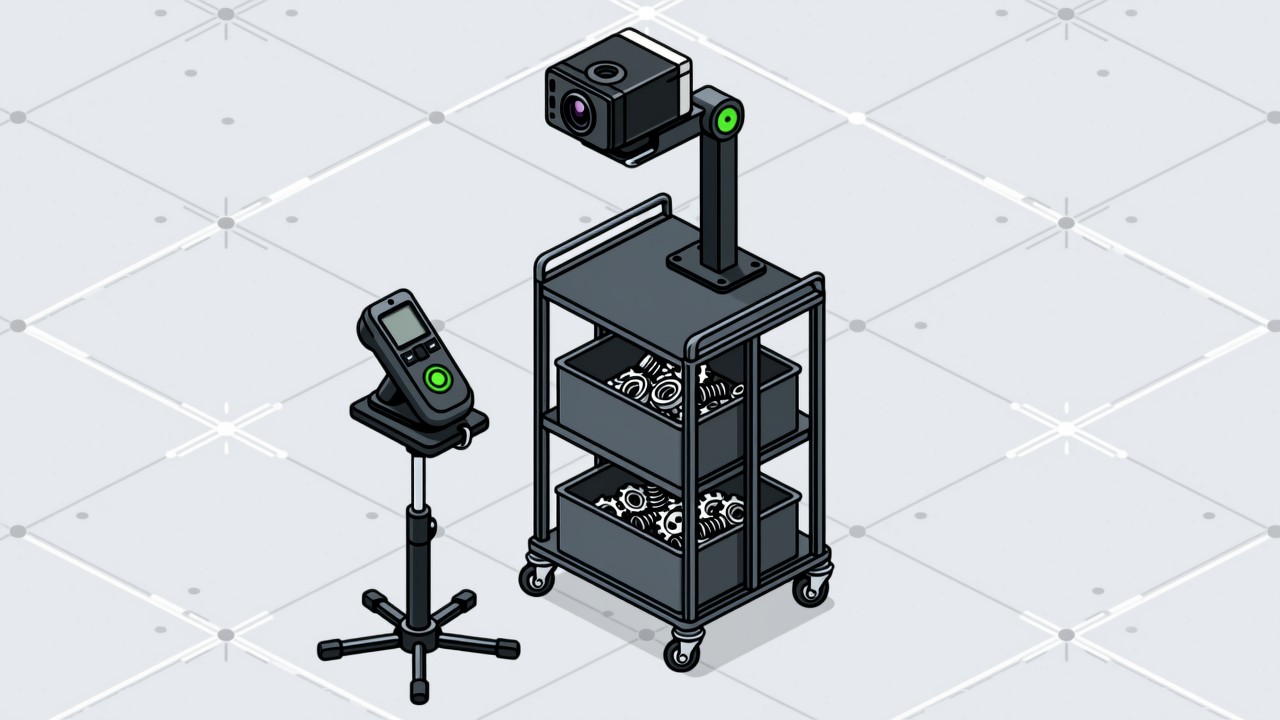
Kitting verification is attractive because it looks like one picture: photograph the finished kit and check that every item is present and correct. The physical obstacle is resolution. A cart holding a dozen small parts may span a metre, and identifying parts a few centimetres across within that field needs a great many pixels; the pixel count on each part falls below what identification requires. Three practical responses exist. Photograph the kit in sections, accepting the extra capture time and the need to track which section is which. Constrain the layout with dividers or a labelled tray so every part has one fixed position, which turns a hard identification problem into a much easier presence problem. Or split the verification across the pick steps, checking each item as it is placed rather than the completed kit, which is often the most reliable and also catches the error at the point it happens. The trade-offs behind these choices sit in choosing a camera.
The design choices that decide whether it is used
- Time per pick: a verification step that adds noticeable time to every pick will be skipped as soon as the shift is running late. Aim for the time to be invisible rather than merely small.
- Feedback position: the prompt has to be where the operator is looking, not on a screen across the aisle. A signal light at the bin beats a message on a distant monitor.
- Cycle counting interruption: the opportunity to interrupt and correct has to be designed in. Whether the station lets the operator pause without losing the count, and how the system resumes afterwards, decides whether corrections actually happen.
- Error messages that are specific: "wrong part" leaves the operator guessing; "two short — bin B12" does not.
- A path for exceptions: urgent orders, partial picks, damaged stock. Without one, exceptions become a reason to bypass the system entirely, which then spreads.
Measure the baseline first
Before investing, measure the current error rate and, more importantly, where errors are found. That last detail usually changes the design. If most errors are discovered at final inspection, the recovery cost is high and step-level checking pays well. If they surface at the customer, the whole cost structure is different and the case is much stronger. Note also that some warehouses have low error rates already, simply because they are small or their products are easy to distinguish, and for them the honest answer may be that a verification system is not the best next investment. Saying so is more useful than selling one anyway, and the same accounting discipline appears in calculating the cost of an escape.
Picking verification questions we get asked
Can vision check the count of small parts in a bag?
Sometimes, but not by looking through the bag. Transparent bags produce reflections and overlap hides items. Use a fixed counting tray or count at the point of dispensing instead, where the parts are separated and visible.
Our parts look nearly identical. Is vision useless here?
Not useless, but unreliable where the distinguishing feature is genuinely fine. Better options are usually to make the difference visible — a colour mark, a different bin position — or to keep barcodes and accept the label-reading difficulty as the thing to solve.
Do we need to verify every pick?
Not necessarily. If step-level checking is too slow everywhere, verify at the steps with a history of errors, plus a sampling regime elsewhere. Concentrated effort where errors actually occur beats uniform coverage.
Do your picking errors come from wrong parts or wrong counts?
Tell us where errors are discovered today and we will recommend the method that fits.
Related articles
-

Alarm Fatigue: Why the Floor Turns the System Off
Many visual SOP systems are not beaten by technical problems — they are muted by…
Read more → -
Visual SOP Camera Selection and Mounting
Camera selection for visual SOP is not the same as for product inspection. The s…
Read more → -
Vision Monitoring at the Semiconductor Die Bonder
Semiconductor packaging stations are characterised by high precision, fast cycle…
Read more → -
Wrong-Assembly Alarms Without the False Alarms
The most common reason a visual SOP project fails is not poor recognition — it i…
Read more →
Need specific advice for your production line?
Our engineers can share practical approaches to process error prevention and SOP compliance inspection for your scenario.
Request a free trial plan